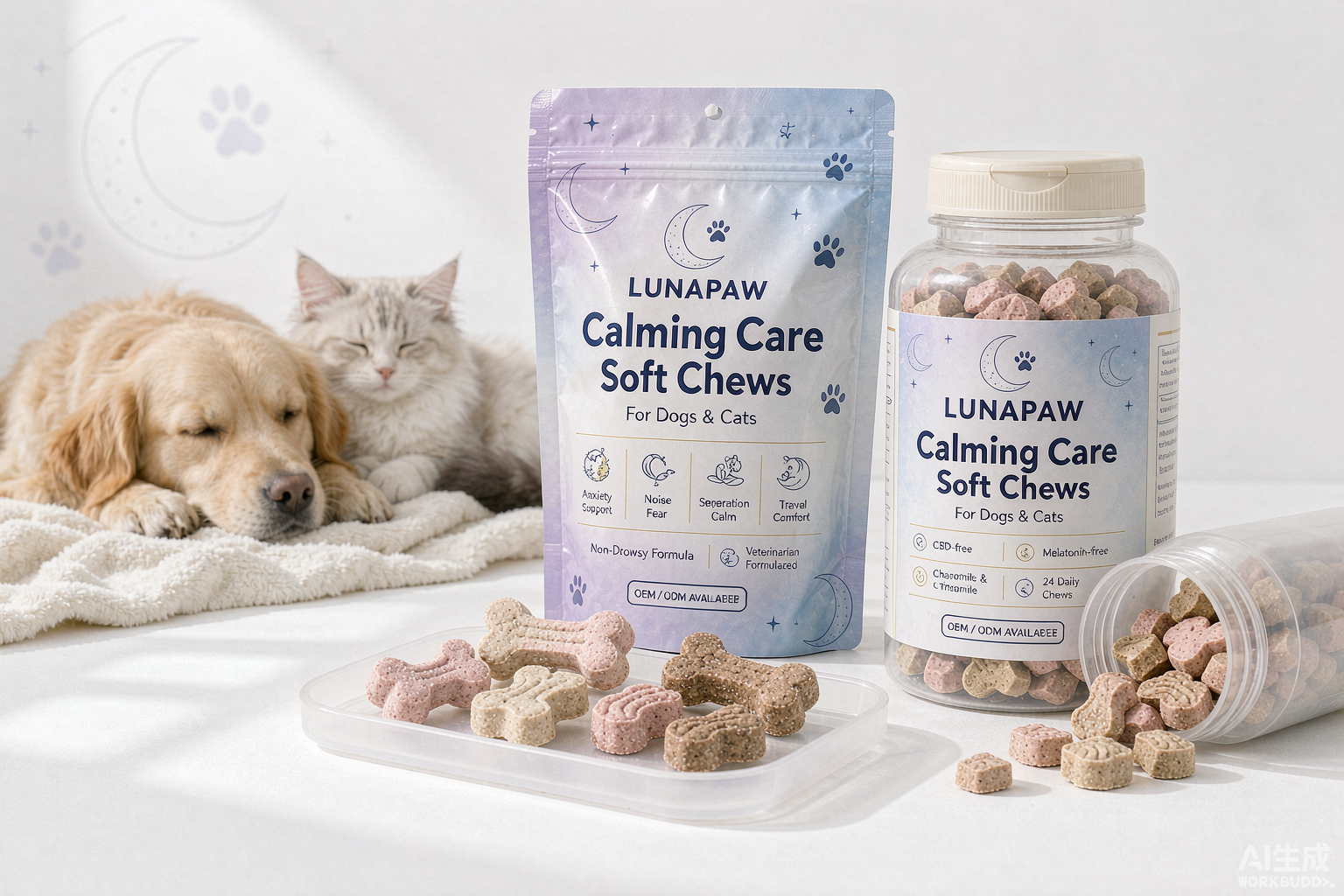
Pet Calming & Anxiety Supplements: A Private-Label Manufacturing Guide for B2B Buyers
Behavioral stress is now one of the most frequently raised concerns among pet owners — thunderstorms, separation, travel, vet visits, and household change all trigger measurable anxiety in dogs and cats. For B2B buyers, calming supplements are a high-velocity, high-margin category with a low barrier to trial. This guide covers the ingredients that work, the formats that sell, and the production standards that protect your brand.
Understanding Stress in Dogs and Cats
Unlike acute pain, anxiety is chronic and invisible until it manifests as destructive behavior, withdrawal, or gastrointestinal upset. Owners often seek a non-prescription, daily-use option before escalating to veterinary medication. That positions calming supplements as a first-line, repeat-purchase product — especially when positioned alongside a broader senior pet care supplement routine, since older animals are disproportionately stress-sensitive.
For buyers, the strategic value is clear: calming SKUs convert on emotion, repurchase on results, and rarely require the regulatory heavy-lifting of pharmaceutical claims. The differentiator is formula credibility.
Proven Ingredients for Calm Behavior
A defensible calming formula rests on actives with documented mechanistic or clinical support. Avoid “proprietary blends” with undisclosed doses — professional buyers and educated consumers increasingly read the label.
L-Theanine and L-Tryptophan
L-Theanine, an amino acid found in green tea, promotes relaxation without sedation by modulating excitatory neurotransmitters. L-Tryptophan is a serotonin precursor that supports mood regulation. Both are well tolerated, stable in chew formats, and suitable for daily use — making them staples of a credible formula.
Chamomile, Valerian, and Botanical Extracts
Traditional botanicals such as chamomile and valerian root provide mild calming effects and let a brand speak to “natural” positioning. The manufacturing nuance is batch-to-batch consistency: botanical potency varies by harvest, so standardized extracts and supplier COAs are essential to keep the product predictable.
Melatonin and CBD-Free Options
Melatonin supports circadian regulation and is useful for noise-phobic and travel-related anxiety. Many markets remain uncertain about cannabidiol (CBD) regulation, so a deliberately CBD-free formula reduces compliance risk for distributors selling across jurisdictions. Buyers should decide their regulatory footprint before specifying actives.
Private-Label Form Factors
Calming products are delivered primarily as:
- Soft chews — the dominant retail format; the “treat-like” delivery drives compliance, especially for daily use.
- Powders — easy to mix into food; useful for cats that reject chews.
- Tablets / capsules — lower cost per dose, preferred in veterinary and bulk channels.
For most consumer brands, soft chews win on adhesion and basket size. The formulation challenge is masking botanical bitterness while keeping the active stable — a process-control problem more than a recipe problem.
Quality and Compliance for Calming Lines
Because calming products are consumed daily and often by anxious, health-compromised animals, the manufacturing bar should be high:
- GMP + HACCP certification — the baseline for any brand selling into quality-conscious or regulated markets, covering both process discipline and hazard control.
- Identity and potency testing — confirm each active is present at label claim, not just listed.
- Contaminant screening — heavy metals, microbes, and residual solvents, particularly important for botanical ingredients.
- Lot traceability — full documentation to support any downstream regulatory or safety inquiry.
Brands that publish their testing posture — even at a high level — build trust faster than those relying on packaging alone.
OEM/ODM: MOQ, Lead Time, and Customization
A typical private-label arrangement for calming SKUs:
- MOQ — 500 bottles per SKU for a custom formula, keeping launch risk low for new entrants and letting established brands run multiple flavor or strength variants.
- Lead time — roughly 10 days from formula and artwork sign-off to finished, labeled product, assuming raw materials are stocked.
- Customization — private-label branding, flavor, active concentration, and format are all adjustable within the manufacturing framework.
Positioning Calming Within a Broader Catalog
Calming rarely stands alone. The strongest catalogs connect it to adjacent categories — for example a heart health supplement line, since chronic stress is a recognized contributor to cardiovascular load, or a weight management supplement for comfort-seeking, stress-eating pets. Educational content that explains these links turns a single impulse purchase into a multi-SKU relationship.
For B2B buyers, the formula is simple: choose actives with published mechanisms, insist on GMP+HACCP production with real testing, and enter with a conservative MOQ. Do that, and calming becomes a reliable, repeatable line rather than a seasonal fad.