Why Pet Multivitamin Supplements Are Becoming a Category Standard
Across the global pet care market, complete-and-balanced nutrition is no longer the end point of the conversation. Pet parents increasingly treat a daily pet multivitamin supplement as routine preventive care — the same way they treat their own multivitamin. For brand owners and private-label buyers, this shift is more than a trend: multivitamins are one of the most defensible, repeat-purchase SKUs in the supplement portfolio, and they work as an entry product that later upsells into condition-specific lines.
As an OEM/ODM manufacturer of pet nutritional supplements, we work with brands in the US, EU, and Southeast Asia, and the pattern is consistent: a well-formulated multivitamin is usually the first SKU a brand launches, and the one that anchors customer trust. In this article we break down what a competitive pet multivitamin contains, how to formulate it for different life stages, and what manufacturing standards matter when you select a contract manufacturer.
What a Professional-Grade Pet Multivitamin Should Contain
A credible multivitamin is not a laundry list of trace ingredients at meaningless doses. Regulatory bodies such as AAFCO provide nutrient profiles for dogs and cats, and a serious formulation is built around gaps between typical home-prepared or wet-food diets and those profiles. The following actives form the backbone of most market-ready formulas:
Core Vitamins and Their Functional Roles
- Vitamin A — vision, skin integrity, and epithelial health.
- B-complex (B1, B2, B6, B12, niacin, folate) — energy metabolism, nervous system function, and appetite regulation, especially valuable for senior pets and picky eaters.
- Vitamin D3 — calcium-phosphorus balance and skeletal development; one of the most commonly deficient vitamins in homemade diets.
- Vitamin E — antioxidant support that protects cell membranes and complements skin and coat formulas such as a dedicated pet skin and coat supplement.
- Vitamin C — antioxidant recycling and immune support, particularly relevant for aging dogs and cats.
Minerals and Co-Factors
- Zinc, selenium, and manganese — antioxidant enzymes, wound healing, and connective tissue support.
- Calcium and phosphorus in balanced ratios — critical for growing puppies and kittens, with attention to the Ca:P ratio rather than absolute amounts.
- Iron and copper — hematopoiesis and oxygen transport, often relevant for performance and working dogs.
Functional Add-Ons That Raise Perceived Value
Many successful private-label multivitamins layer functional actives onto the base vitamin-mineral chassis: taurine for cardiac and retinal health (essential for cats), glucosamine and chondroitin for mobility, omega-3 fatty acids for skin and coat, and probiotics for gut health. These add-ons let one SKU speak to multiple consumer concerns, and they create natural cross-sell paths into specialist products — for example, an immune-focused formula like our pet immune support supplement or a life-stage product such as our senior pet care supplement.
Formulating by Life Stage and Market Positioning
One of the most common mistakes we see from first-time brand owners is launching a single “all-in-one” multivitamin for every animal. The market rewards specificity:
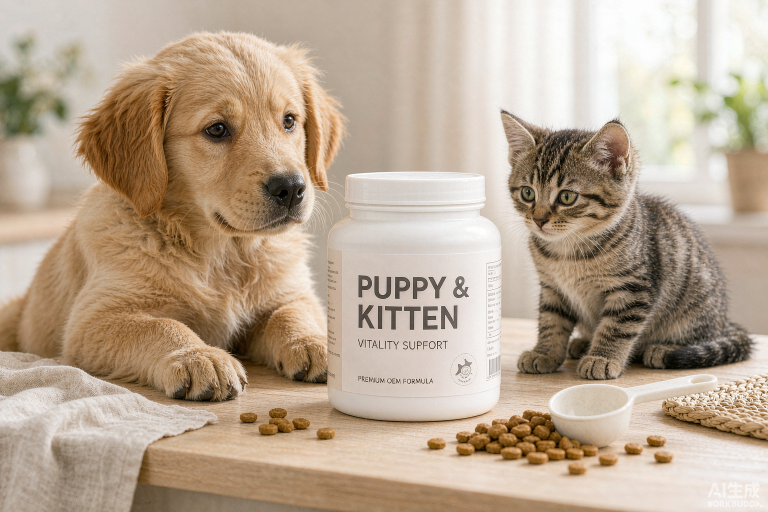
Puppy and Kitten Formulas
Growth-stage formulas emphasize DHA, calcium-phosphorus balance, and higher B-vitamin density. Because growing animals have narrow tolerance windows for certain minerals, dosage precision and manufacturing consistency matter more than in adult maintenance formulas.
Adult Maintenance Formulas
The workhorse SKU. A balanced vitamin-mineral core with moderate functional add-ons covers the broadest buyer group and supports subscription models — the category with the highest lifetime value for DTC brands.
Senior Formulas
Older pets benefit from increased antioxidant load (vitamin E, vitamin C, selenium), joint-support actives, and B12 for cognitive and appetite support. Pairing a senior multivitamin with a targeted cognitive product creates a credible “healthy aging” brand line.
Dosage Forms: Soft Chews vs. Tablets vs. Powders
Dosage form is a commercial decision as much as a technical one. From our production data across client brands:
- Soft chews dominate the US market — high palatability, easy dosing, premium positioning. They require moisture and texture control, which is where GMP-grade process discipline shows up in shelf-life stability.
- Tablets remain the most cost-efficient format for volume brands and veterinary channels, with the longest shelf life.
- Powders win for multi-pet households and food-topping use cases, and they simplify dose adjustment across body weights.
Palatability testing is non-negotiable regardless of format. A nutritionally perfect formula that a dog refuses is a return-rate problem, not a formulation problem.
What to Demand From an OEM/ODM Manufacturing Partner
When evaluating a contract manufacturer for a pet multivitamin, the checklist should go far beyond price per unit:
Quality Systems and Certifications
Insist on documented GMP and HACCP systems covering raw material qualification, in-process controls, and finished-goods testing. Ask for certificates of analysis per batch, including heavy metals and microbiology. These documents are what your regulatory reviewers, Amazon compliance teams, and retail buyers will ask for first.
Formulation and Regulatory Support
A capable ODM partner doesn’t just manufacture your recipe — they help you align label claims with AAFCO or EU feed regulations in your target market, advise on permissible nutrient maximums, and flag ingredient restrictions before they become customs problems.
Flexible MOQ and Lead Time
For emerging brands, a high MOQ is the single biggest barrier to launching. Our facility runs GMP + HACCP-certified production with a minimum order quantity of 500 bottles per SKU and a standard lead time of approximately 10 days — a profile designed specifically so that new brands can test a market without locking capital into a container of inventory. Established brands can scale the same SKU architecture into larger runs without reformulation.
Common Formulation Pitfalls to Avoid
- Over-supplementation of vitamin D. Toxicity risk is real and AAFCO sets a maximum for a reason; this is a formulation-safety item auditors check first.
- Mineral antagonism. Excess zinc or calcium can interfere with copper and iron absorption — ratios matter more than totals.
- Ignoring flavor system interaction. Certain vitamins and minerals destabilize in high-moisture soft chew matrices; stability testing under real storage conditions should precede any launch.
- Copy-paste labels across markets. EU and US labeling rules differ on tolerances, claims, and formatting — one artwork does not fit all.
Frequently Asked Questions
Can a multivitamin replace condition-specific supplements?
No. A multivitamin covers nutritional baseline gaps; targeted concerns — joints, kidneys, cognition, anxiety — require active dosages that a broad-spectrum formula cannot carry. The commercial model works best as a multivitamin anchor plus specialist SKUs, cross-linked through your content strategy.
What is a realistic MOQ for a first private-label run?
For a soft chew or tablet multivitamin, 500 bottles per SKU is a practical entry point: enough to run full quality controls and stability sampling, small enough to validate a channel before scaling.
How long does OEM development take?
With an established white-label base formula, sampling and label finalization typically run 2–3 weeks and production approximately 10 days after artwork approval. Fully custom formulations add stability and palatability testing rounds.
Key Takeaways for Brand Owners
A pet multivitamin supplement is the most reliable anchor SKU in the supplement category: broad demand, subscription-friendly, and a natural gateway to condition-specific lines. Success depends less on exotic ingredients and more on three manufacturing fundamentals — a formulation aligned to AAFCO nutrient profiles, a dosage form with proven palatability and stability, and a GMP + HACCP-certified production partner with MOQ and lead time terms that match your growth stage. If you are evaluating white-label options, our team provides base formulas, regulatory documentation, and samples from our broader pet supplement manufacturing line so you can launch with confidence.