The Case for a Dedicated Recovery SKU
Every other supplement category on your shelf is about maintenance. Recovery is different. A dog with loose stool for two days is not a maintenance customer — the owner is anxious, searching late at night, and willing to buy the first product that looks credible. That urgency produces some of the highest conversion rates in the pet channel, and it is almost universally under-served by brands that only sell a general digestive product.
A pet diarrhea recovery supplement is a short-course, high-intent SKU that sits alongside maintenance digestion rather than replacing it. It builds trust quickly, generates reviews fast, and pulls the customer into the rest of the digestive line. As an OEM/ODM manufacturer producing for brands in North America, the EU, and Southeast Asia, we have watched this category become one of the strongest repeat performers in portfolios that get the claim boundaries right.
What a Recovery Formula Can and Cannot Claim
Scope discipline matters more here than anywhere else, because diarrhea is a clinical sign with dozens of possible causes. A supplement supports recovery from ordinary, self-limiting digestive upset. It does not treat infection, parasitism, toxicity, foreign bodies, or chronic enteropathy, and must never be positioned that way. The legitimate territory is narrower and fully defensible: fluid and electrolyte support, faecal consistency support through soluble fibre and mucilage, gut lining comfort, and microbiome re-establishment — the step owners understand most intuitively and the strongest marketing hook.
Two sentences belong on every pack and listing: this is a nutritional supplement, and persistent or bloody diarrhea, lethargy, vomiting, or fever requires veterinary attention. Brands that include that guidance gain credibility rather than losing sales, and stay clear of regulatory trouble.
Formulating the Recovery Matrix
A strong formula is built in four functional layers. The common mistake is treating it as a probiotic with a fibre top-up, which leaves the electrolyte and mucosal layers unaddressed.
Layer One — Electrolytes and Fluid Support
This is the layer that justifies the word recovery. Formulate to a defined profile rather than scattering a pinch of sodium and potassium: sodium, potassium and chloride in balanced ratio (potassium loss is substantial in loose stool and routinely ignored by copycats); a modest level of dextrose to support sodium co-transport across the intestinal epithelium, a principle borrowed from human oral rehydration and one of the few technical stories that genuinely impresses buyers; and magnesium plus zinc, the latter supporting normal intestinal lining integrity.
Layer Two — Binding and Bulking Agents
- Kaolin and pectin — the traditional pairing; regulatory treatment varies by market and some buyers now prefer alternatives on clean-label grounds.
- Pumpkin and pumpkin fibre — familiar to pet parents, easy to label, genuinely useful for stool consistency.
- Psyllium husk — gels in the gut; dose control matters because excess fibre can worsen discomfort.
- Montmorillonite clay — common in EU and Asian formulas; must be food-grade and heavy-metal tested.
- Slippery elm and marshmallow root — mucilage botanicals supporting mucosal comfort.
Layer Three — Microbiome Re-Establishment
Multi-strain probiotics — typically Enterococcus faecium, Bacillus subtilis, Lactobacillus and Bifidobacterium — with spore-formers preferred for shelf stability in chews and powders. Keep prebiotic load moderate in a recovery product; a large fermentable load during acute upset is counterproductive. Postbiotics and heat-killed strains are increasingly specified because they survive processing and ambient storage, and yeast culture with beta-glucans supports normal hindgut microbial balance at low cost.
Layer Four — Mucosal and Bile Support
Glutamine is the primary fuel for enterocytes and is the most under-used ingredient in this category given how directly relevant it is; pair it with N-acetyl glucosamine for mucosal support. Artichoke and bile-acid support is relevant where loose stool reflects dietary fat intolerance rather than infection, and omega-3 EPA/DHA supports the normal inflammatory response in the gut wall, microencapsulated in chew formats.
How This Sits Beside Your Maintenance Digestive SKU
The commercial architecture matters as much as the formula. Position recovery as a short intensive course of three to seven days, and let the maintenance product carry the daily, subscription-friendly role. Keeping the two distinct prevents internal competition and doubles shelf presence. Our guide to pet digestive health supplements covers the maintenance architecture; the recovery SKU is the acute counterpart and should link to it as the follow-on purchase. The same logic applies to probiotics: a general pet probiotic supplement is a daily habit while recovery is a high-dose intervention, and the two should be cross-sold rather than merged. Because gut barrier and immune function are one conversation in most buyers’ minds, an immune support supplement is the third natural adjacency in a digestive bundle.
Format Selection for a Short-Course Product
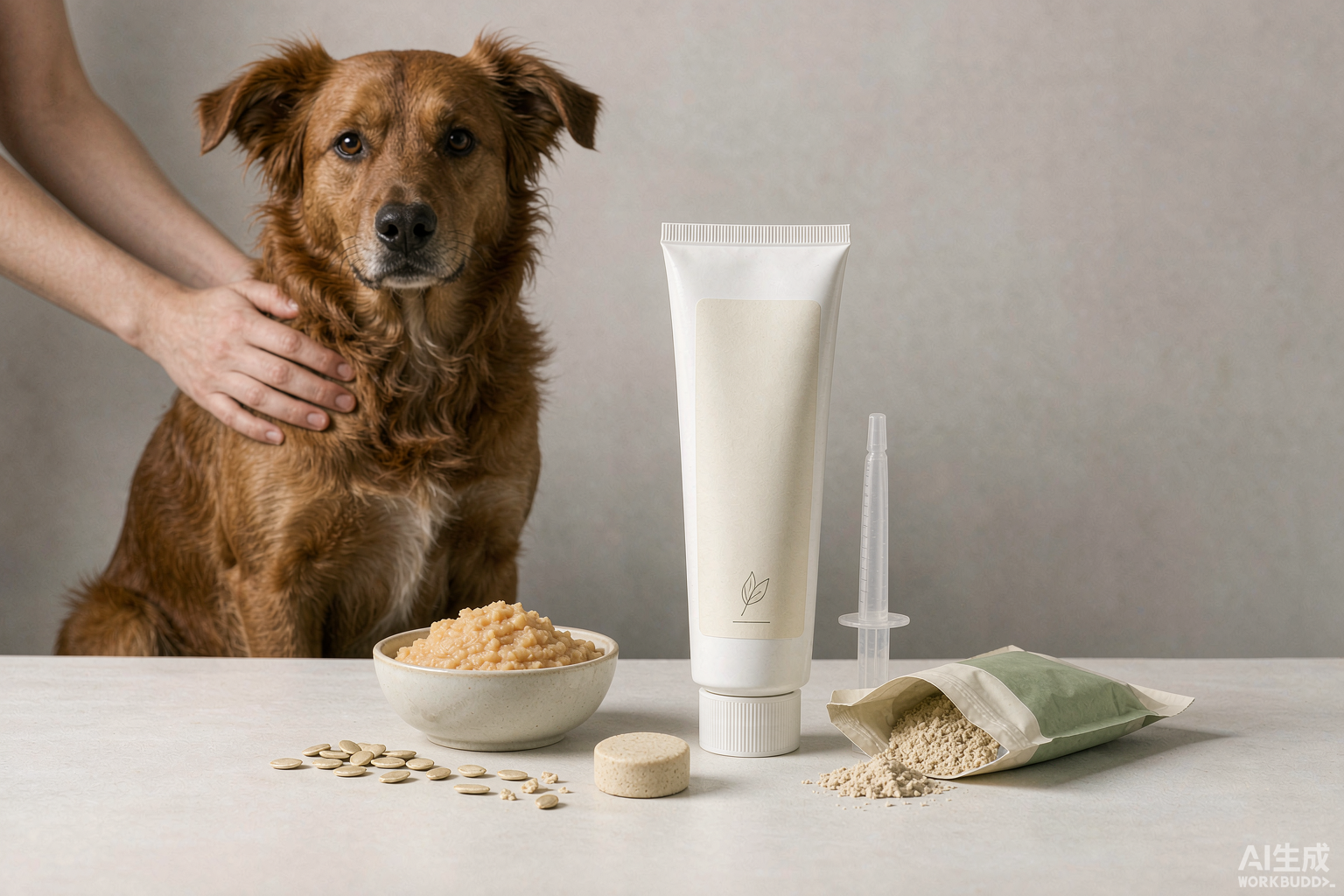
- Pastes and gels — strongest fit: easy to administer to a reluctant animal, perceived as fast-acting, suited to a syringe-based multi-day course. Shelf stability and preservative validation are the development risks.
- Powders and sachets — excellent for unit-dose courses and multi-pet households; sachets allow precise electrolyte dosing by body weight.
- Soft chews — best compliance, but a difficult matrix for live probiotics and electrolytes; postbiotic approaches solve this.
- Liquid drops — fast absorption perception and strong appeal in Asian markets; dose volume limits use in large dogs.
Positioning Angles That Convert
The Three-Day Kit
Bundling a fixed three or five-day course with dosage guidance removes decision anxiety, lifts average order value above a single tub, and naturally limits use to the acute window where the claim is safest.
Travel and Boarding Kit
Dietary change, travel stress and kennel environments are the most predictable triggers of ordinary loose stool. Positioned for travel, this becomes a planned purchase rather than a panic purchase — better margin, fewer returns.
Puppy and Rescue Angle
Young and rehomed animals are the highest-risk groups. This audience buys on veterinary-adjacent credibility, so investment in documentation pays back directly.
Manufacturing Controls Specific to This Category
- Water activity and moisture — critical in pastes and chews; elevated water activity in a high-sugar electrolyte matrix is the fastest route to spoilage.
- Probiotic viability — count at release and at end of shelf life; ask for stability data, not the label claim.
- Heavy metals in clays and botanicals — montmorillonite, kaolin and root powders require a certificate of analysis per lot.
- Electrolyte assay — sodium and potassium verified in the finished matrix, since both shift during processing.
- Allergen and cross-contact control — recovery products go to sensitive animals; line clearance documentation matters.
- Certification and terms — GMP and HACCP with a defined scope, 500 bottles per SKU minimum, and roughly 10 days production lead time, short enough to launch a travel-season SKU without over-committing inventory.
Launching the SKU
Recovery is the one pet supplement category where urgency is built into the search query, which makes it a strong acquisition product: it brings customers in at high intent, then hands them to the maintenance digestive and probiotic lines for the long-term relationship. Build the formula around electrolyte balance, mucosal support and validated probiotic viability; write the claim matrix conservatively; and let the on-pack veterinary guidance do the credibility work. Brands that get those three things right own a category almost nobody has properly built yet.