
Introduction
Launching a successful pet supplement brand requires more than a great idea—it demands a strategic partnership with an experienced manufacturer who can navigate formulation, compliance, production, and packaging complexities. Whether you’re an established retailer expanding your line or an entrepreneur entering the $2.5 billion pet supplement market, understanding the OEM/ODM development process is crucial for success.
This comprehensive guide walks you through every stage of bringing a pet supplement from concept to consumer shelves, using DOOWOO’s proven 15+ year track record with 500+ global partner brands as our framework.
Understanding OEM vs. ODM vs. Private Label
Before diving into the process, let’s clarify these commonly confused terms:
OEM (Original Equipment Manufacturing)
- You provide: Complete formula, specifications, and quality requirements
- Manufacturer provides: Production facilities, quality control, and regulatory compliance
- Best for: Brands with in-house R&D teams and proprietary formulations
ODM (Original Design Manufacturing)
- You provide: Product concept, target market, and desired benefits
- Manufacturer provides: Formula development, ingredient sourcing, testing, and production
- Best for: Entrepreneurs and retailers without formulation expertise
Private Label
- You provide: Brand identity and marketing strategy
- Manufacturer provides: Pre-developed, market-tested formulations ready for branding
- Best for: Quick market entry with lower upfront investment
Many manufacturers, including DOOWOO, offer all three models, allowing you to choose the approach that best fits your resources and timeline.
Phase 1: Discovery and Consultation (Weeks 1-2)
Initial Needs Assessment
Your manufacturing partner should begin by understanding:
- Target Species: Dogs, cats, exotic pets, or multi-species?
- Health Focus: Joint support, digestive health, skin & coat, immune function, or multi-benefit?
- Market Positioning: Budget-friendly, mid-tier, or premium luxury?
- Distribution Channels: Online DTC, veterinary clinics, pet specialty stores, or mass retail?
- Geographic Markets: Domestic only, or international expansion planned?
Regulatory Landscape Review
Different markets have varying requirements:
An experienced manufacturer will guide you through these complexities early, preventing costly delays later.
Phase 2: Formulation Development (Weeks 3-8)
For ODM Projects: Ingredient Selection
The R&D team will:
- Identify Active Ingredients: Based on scientific literature and market trends
- Determine Dosage Levels: Balancing efficacy with safety margins
- Select Carrier Materials: Ensuring stability and palatability
- Choose Delivery Format: Tablets, soft chews, powders, pastes, or liquids
Palatability Testing
This critical step often determines product success. Advanced manufacturers conduct:
- Multi-round taste trials with diverse pet populations
- Acceptance rate tracking (target: 90%+)
- Flavor optimization using natural attractants
- Texture refinement for optimal mouthfeel
Case Example: DOOWOO’s freeze-dried fish oil meatballs achieved a 95%+ acceptance rate through iterative flavor profiling, solving the common challenge of pets refusing omega-3 supplements.
Stability and Shelf-Life Testing
Laboratory testing verifies:
- Nutrient retention over 12-24 months
- Resistance to heat, humidity, and light exposure
- Packaging compatibility (no leaching or degradation)
- Microbial stability (especially for moist formats like pastes and soft chews)
Phase 3: Prototype and Sampling (Weeks 9-12)
First Production Run
A small batch (typically 500-2,000 units) is produced for:
- Client review and approval
- Internal quality verification
- Third-party laboratory testing (if required)
- Focus group testing with target customers
Packaging Design Collaboration
While not always part of the manufacturer’s scope, many offer:
- Structural packaging design (bottle shapes, pouch styles)
- Label template creation meeting regulatory requirements
- Material recommendations (glass vs. PET, recyclable options)
- Mockup production for photography and marketing
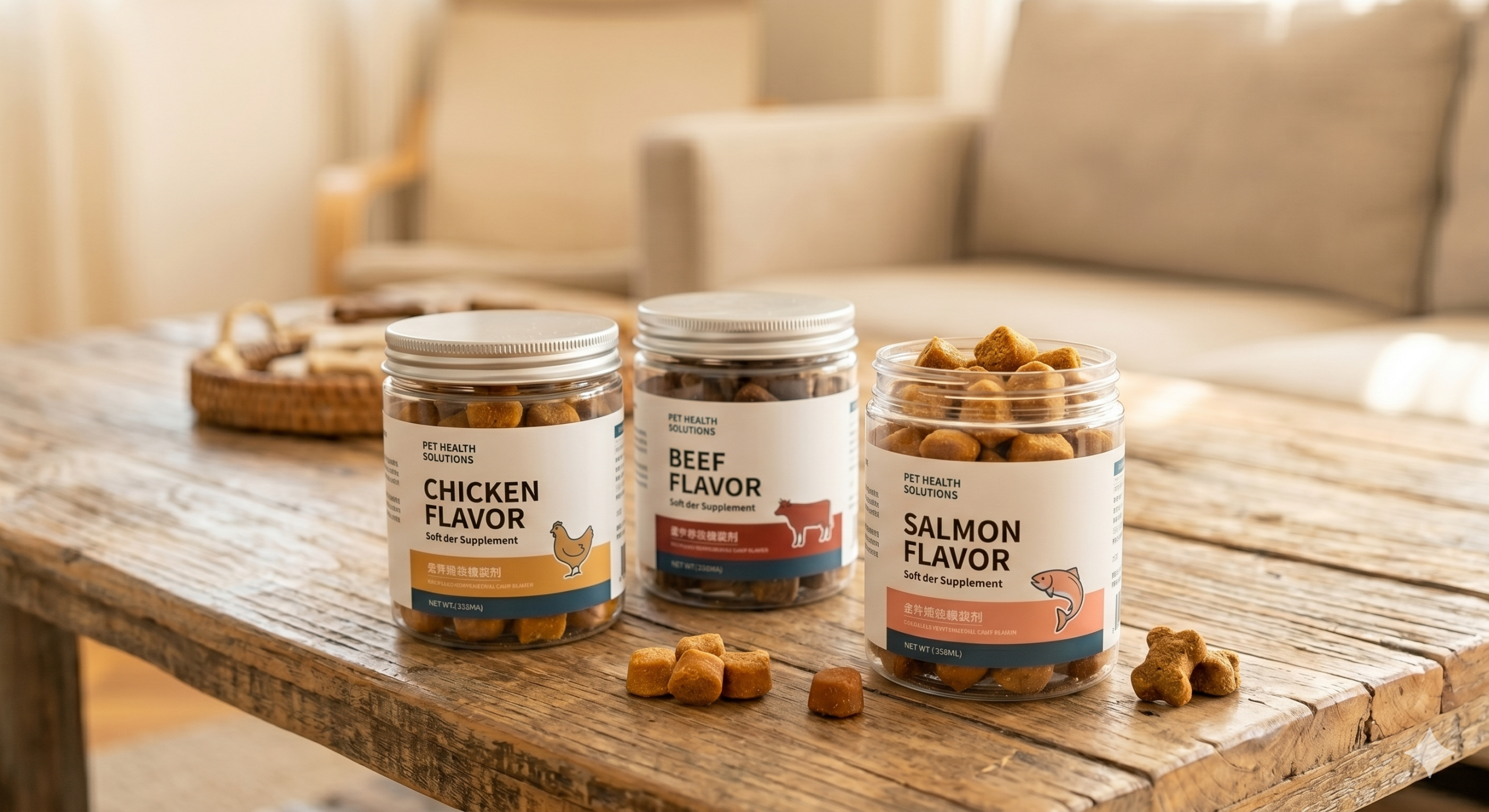
DOOWOO clients benefit from minimalist modern packaging designs that align with European and North American aesthetic preferences, enhancing shelf appeal.
Phase 4: Compliance and Certification (Weeks 10-14, overlapping)
Documentation Preparation
Your manufacturer should provide:
- Certificate of Analysis (COA) for each batch
- Ingredient sourcing records (traceability documentation)
- Manufacturing process records (GMP compliance)
- Safety data sheets (SDS) for hazardous materials
- Allergen statements (if applicable)
Third-Party Verification
Independent laboratories may test for:
- Heavy metal contamination (lead, mercury, arsenic)
- Microbial load (total plate count, E. coli, Salmonella)
- Potency verification (active ingredient levels match label claims)
- Contaminant screening (pesticides, mycotoxins)
Having GMP, HACCP, FDA, and ISO 9001 certifications streamlines this process significantly, as auditors recognize these standards as markers of reliable quality systems.
Phase 5: Scale-Up Production (Weeks 15-20)
Pilot Batch Validation
Before full-scale production:
- Produce a medium-sized batch (10,000-50,000 units)
- Conduct thorough quality checks at every stage
- Verify packaging line efficiency and seal integrity
- Confirm labeling accuracy and barcode functionality
Full Production Launch
With pilot validation complete:
- Schedule production runs based on your forecasted demand
- Implement batch tracking systems for traceability
- Establish quality hold procedures for any deviations
- Coordinate logistics and warehousing arrangements
DOOWOO’s capacity of 1.5 million+ units monthly ensures they can accommodate rapid scaling without compromising quality or lead times.
Phase 6: Quality Assurance and Continuous Improvement
Ongoing Quality Control
Every production batch undergoes:
- Incoming material inspection: Raw ingredients verified before use
- In-process monitoring: Critical control points checked during manufacturing
- Final product testing: Finished goods sampled and analyzed
- Retention samples: Archived for future reference or complaint investigation
Feedback Loop Integration
Successful partnerships include:
- Quarterly business reviews discussing sales performance and customer feedback
- Reformulation adjustments based on market response
- New product development brainstorming sessions
- Cost optimization initiatives as volumes increase
One DOOWOO client reported proactive problem-solving from their account management team, who identified a potential supply chain disruption six weeks in advance and secured alternative ingredients without impacting delivery schedules.
Common Pitfalls to Avoid
❌ Rushing the Formulation Phase
Skipping adequate palatability testing leads to high return rates and negative reviews. Invest time upfront to get it right.
❌ Underestimating Regulatory Complexity
Assuming “natural” ingredients don’t require compliance documentation is a costly mistake. Work with manufacturers experienced in your target markets.
❌ Choosing Price Over Quality
Significantly below-market pricing often indicates corner-cutting on ingredient quality, testing rigor, or facility standards.
❌ Lack of Clear Communication
Establish regular check-in schedules, designated points of contact, and documented approval processes to prevent misunderstandings.
Timeline Summary
Note: Timelines vary based on complexity, regulatory requirements, and revision cycles.
Why Partner with DOOWOO?
With 15+ years in business, 1.5M+ units produced monthly, and partnerships with 500+ verified brands worldwide, DOOWOO offers:
✅ Comprehensive Capabilities: OEM, ODM, and private label across tablets, soft chews, powders, pastes, liquids, and emulsions
✅ Regulatory Expertise: GMP, HACCP, FDA, and ISO 9001 certified facilities enabling global market access
✅ R&D Excellence: Advanced formulation science with proven palatability optimization
✅ Scalable Production: From small trial batches to millions of units monthly
✅ Responsive Communication: Dedicated account managers providing proactive support
✅ Quality Commitment: Rigorous testing at every stage ensuring consistent, safe, effective products
Conclusion
Developing a successful pet supplement requires careful planning, scientific rigor, and a trustworthy manufacturing partner. By understanding each phase of the OEM/ODM process—from initial consultation through scale-up production—you can make informed decisions that protect your investment and accelerate time-to-market.
Whether you’re launching your first product or expanding an existing line, partnering with an experienced manufacturer like DOOWOO provides the expertise, infrastructure, and reliability needed to thrive in the competitive pet supplement industry.